E-Signature Legal Validity
Typeflow's electronic signatures are legally binding and enforceable. This article explains why and how we ensure compliance with major e-signature laws worldwide.
Are Electronic Signatures Legal?
Yes. Electronic signatures have been legally recognized for over 20 years in most countries.
The key principle is simple: a signature doesn't have to be ink on paper to be valid. What matters is:
Intent to sign - The signer meant to sign the document
Consent - The signer agreed to use electronic means
Association - The signature is linked to the document
Record retention - The signed document can be stored and reproduced
Typeflow ensures all four requirements are met for every signature.
Laws We Comply With
United States
ESIGN Act (2000)
Electronic Signatures in Global and National Commerce Act
Federal law covering all 50 states
Electronic signatures have the same legal weight as handwritten signatures
Electronic records satisfy any law requiring written records
UETA (1999)
Uniform Electronic Transactions Act
Adopted by 49 states (all except New York, which has similar laws)
Provides state-level framework for e-signatures
Confirms electronic records and signatures are legally valid
European Union
eIDAS Regulation (2014)
Electronic Identification, Authentication and Trust Services
Applies to all 27 EU member states
Defines three levels of electronic signatures:
| Level | Description | Typeflow |
|---|---|---|
| Simple Electronic Signature (SES) | Basic e-signature with signer identification | ✅ Supported |
| Advanced Electronic Signature (AES) | Uniquely linked to signer, capable of detecting changes | ✅ Supported |
| Qualified Electronic Signature (QES) | Requires certified device and qualified certificate | ❌ Not supported |
Typeflow provides Simple Electronic Signatures which are legally valid for most business documents in the EU.
Other Jurisdictions
| Country/Region | Law | Status |
|---|---|---|
| United Kingdom | Electronic Communications Act 2000 | ✅ Valid |
| Canada | PIPEDA, provincial laws | ✅ Valid |
| Australia | Electronic Transactions Act 1999 | ✅ Valid |
| Singapore | Electronic Transactions Act | ✅ Valid |
| Japan | Act on Electronic Signatures | ✅ Valid |
How Typeflow Ensures Legal Validity
We capture comprehensive evidence for every signature to prove authenticity and intent.
1. Signer Identification
For each signer, we record:
| Data | Purpose |
|---|---|
| Email address | Identifies who was invited to sign |
| Name | As provided by sender or entered by signer |
| Unique signing link | One-time token tied to specific signer |
2. Intent to Sign
We capture explicit actions showing the signer intended to sign:
Clicked signing link - Active choice to open document
Completed each field - Deliberate action for every signature/field
Clicked "Complete Signing" - Final confirmation of intent
3. Audit Trail
Every action is logged with timestamp and metadata:
| Event | Data Captured |
|---|---|
| Document viewed | Timestamp, IP address, browser, location |
| Field completed | Which field, value entered, timestamp |
| Signing completed | Final timestamp, total duration |
4. Document Integrity
We use cryptographic hashing to prove the document hasn't been altered:
| Hash | Purpose |
|---|---|
| Original document SHA-256 | Proves what document was sent for signing |
| Signed document SHA-256 | Proves final document hasn't been modified |
If even one character changes, the hash completely changes - making tampering detectable.
5. Tamper-Evident Seal
The signed PDF embeds:
All signatures and field values directly in the document
Certificate of Completion with full audit trail
Cannot be edited without breaking the PDF structure
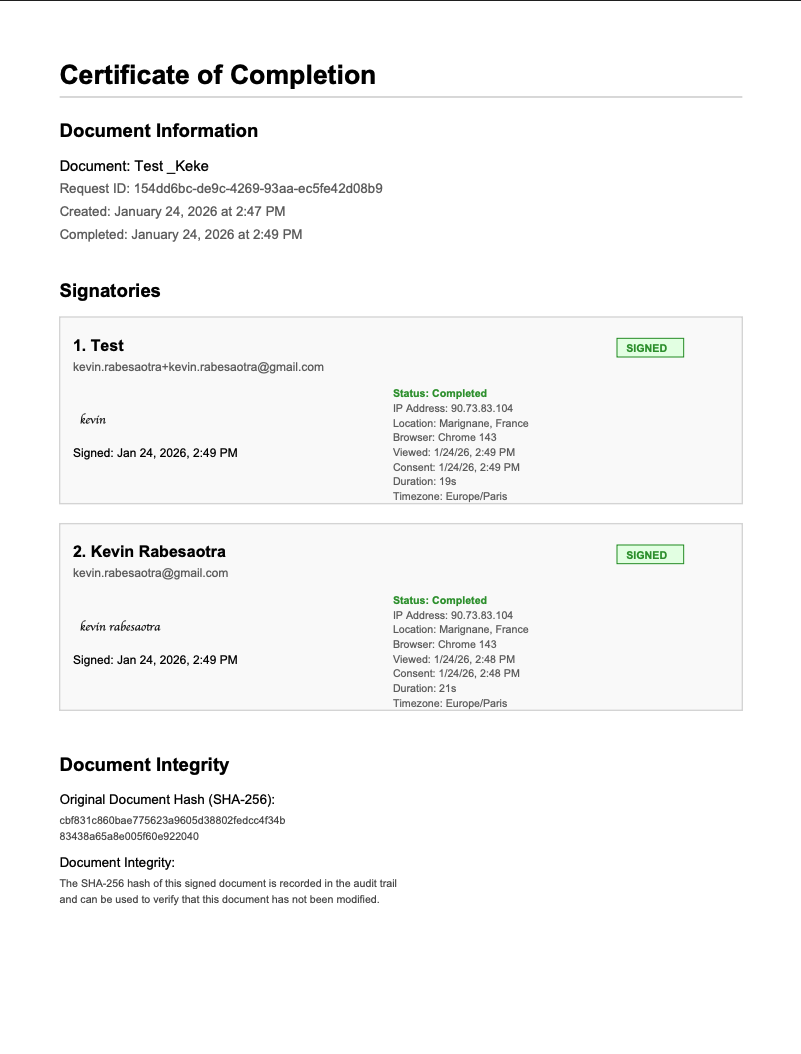
Certificate of Completion
Every signed document includes a Certificate of Completion page that serves as legal evidence.
What's Included
┌─────────────────────────────────────────────────────────────┐
│                 CERTIFICATE OF COMPLETION                    │
├─────────────────────────────────────────────────────────────┤
│                                                             │
│  Document Information                                       │
│  • Document name and unique ID                              │
│  • Creation date and completion date                        │
│                                                             │
│  Signer Details (for each signer)                          │
│  • Name and email                                          │
│  • Signature image                                         │
│  • Signing timestamp                                       │
│  • IP address and geographic location                      │
│  • Browser and device information                          │
│  • Time spent viewing before signing                       │
│                                                             │
│  Document Integrity                                         │
│  • SHA-256 hash of original document                       │
│  • SHA-256 hash of signed document                         │
│                                                             │
│  Legal Statement                                            │
│  "This document was signed electronically in accordance    │
│   with the US ESIGN Act, UETA, and EU eIDAS Regulation"    │
│                                                             │
└─────────────────────────────────────────────────────────────┘
Why This Matters
If a signature is ever disputed, the Certificate provides:
Proof of identity - Who signed (email, IP, location)
Proof of intent - They actively completed the signing process
Proof of timing - Exact date and time of signature
Proof of document state - Hash proves document wasn't altered
What Can Be Signed Electronically?
Most business and personal documents can be legally signed electronically:
| Category | Examples |
|---|---|
| Contracts | Service agreements, NDAs, partnerships |
| Sales | Purchase orders, quotes, invoices |
| HR | Offer letters, onboarding forms, policies |
| Real Estate | Lease agreements, rental applications |
| Finance | Loan applications, account openings |
| Legal | Consent forms, releases, settlements |
| Healthcare | Patient consent, HIPAA authorizations |
Documents That Require Handwritten Signatures
Some documents still require traditional "wet" signatures by law:
United States
Wills and testamentary trusts
Adoption and divorce papers
Court orders and notices
Utility cancellation notices
European Union
Family law documents (marriage, adoption)
Real estate transfers (in some countries)
Notarized documents
General Exclusions
Documents requiring notarization
Documents requiring witnesses present
Government-issued documents (passports, IDs)
When in doubt, consult with a legal professional for high-stakes documents.
FAQ
Is a typed signature as valid as a drawn signature?
Yes. The law doesn't distinguish between drawn and typed signatures. What matters is the intent to sign, not the visual appearance.
Do I need witnesses for e-signatures?
For most documents, no. The audit trail serves as evidence. Some specific document types may require witnesses by law.
Can e-signatures be used in court?
Yes. E-signatures are regularly admitted as evidence. The Certificate of Completion and audit trail provide the documentation needed.
Are e-signatures valid for international contracts?
Generally yes, if both parties' countries recognize e-signatures. Most developed countries do. Check specific requirements for your situation.
What if someone claims they didn't sign?
The audit trail shows their email received the link, their IP address accessed it, their browser completed the fields, and they clicked "Complete Signing". This is strong evidence of intent.
Is Typeflow compliant with GDPR?
Yes. We only collect data necessary for the signing process and legal compliance. Signer data is stored securely and can be deleted upon request.
Do you offer Qualified Electronic Signatures (QES)?
No. QES requires certified hardware devices and is typically only needed for specific regulated industries in the EU. Simple Electronic Signatures are valid for the vast majority of use cases.
Summary
| Requirement | How Typeflow Meets It |
|---|---|
| Signer identification | Email verification, unique tokens |
| Intent to sign | Active completion of signing process |
| Document integrity | SHA-256 cryptographic hashing |
| Audit trail | Comprehensive logging of all events |
| Record retention | Secure storage, downloadable PDFs |
| Legal compliance | ESIGN, UETA, eIDAS compliant |